Kathmandu Valley Heritage Guide: Complete Guide (2026)
Kathmandu Valley is a living museum of medieval art, architecture and religion. Seven UNESCO World Heritage monument zones are packed into a 30 km radius: three royal Durbar Squares, two great stupas, and two sacred Hindu temple complexes. Nowhere else on earth lets you walk from a 5th-century stone inscription to a 17th-century palace square and a living Tibetan Buddhist pilgrimage circuit in a single afternoon. This guide is the complete hub for exploring all seven, with suggested itineraries, ticket prices and the cultural thread that ties them together.
Why visit the Kathmandu Valley?
For roughly 600 years the Valley was ruled by three rival kingdoms: Kathmandu, Patan and Bhaktapur. Each royal court tried to outbuild the others, raising ever-grander palaces, pagodas and temples in a competition that produced the densest concentration of medieval architecture in Asia. UNESCO recognised the result in 1979 by inscribing the Kathmandu Valley as a single World Heritage Site containing seven monument zones.
The 2015 earthquake damaged many structures, but more than a decade of restoration later the sites are open, and your ticket money directly funds the repair work. The craftsmen rebuilding carved windows and roof struts today use the same tools and techniques as their Malla-era ancestors, which makes a heritage walk here a living lesson rather than a frozen one.
The thread running through all seven monuments is the Newars, the Valley’s indigenous people, whose language, festivals, cuisine and building craft you will meet at every gate. Keep that thread in mind and the Valley stops being a checklist of sites and becomes one enormous, coherent story.
The seven monument zones at a glance
| Monument zone | Type | Signature sight |
|---|---|---|
| Kathmandu Durbar Square | Royal palace square | Kumari Ghar, residence of the Living Goddess |
| Patan Durbar Square | Royal palace square | Patan Museum and Krishna Mandir |
| Bhaktapur Durbar Square | Royal palace square | 55-Window Palace and Nyatapola Temple |
| Swayambhunath | Buddhist stupa complex | Hilltop stupa with panoramic views |
| Boudhanath | Buddhist stupa complex | Nepal’s largest stupa and the Tibetan kora circuit |
| Pashupatinath | Hindu temple complex | Bagmati ghats and the evening aarti |
| Changu Narayan | Hindu temple complex | Nepal’s oldest dated inscription, from 464 AD |
1. The three Durbar Squares
Each of the three former kingdoms has a royal palace square (Durbar means “palace” in Nepali):
- Kathmandu Durbar Square: the most central and the busiest. Highlights are the Kumari Ghar, home of the Kumari, a young girl revered as the Living Goddess, the rebuilt Kasthamandap pavilion that gave the city its name, and the much-photographed Kal Bhairab statue. Temples stand a few steps apart with constant street life flowing between them.
- Patan Durbar Square: the finest single collection of Newari architecture in Nepal, with the stone Krishna Mandir, the gilded Golden Temple a short walk away, and the excellent Patan Museum inside the old Malla palace.
- Bhaktapur Durbar Square: the best preserved and the calmest, with the 55-Window Palace, the five-storey Nyatapola Temple, the tallest pagoda in Nepal, and a pottery square where artisans still throw clay by hand.
If you only have time for one square, photographers lean toward Bhaktapur for atmosphere, history lovers toward Patan for craft, and everyone ends up at Kathmandu’s anyway because it is a working bazaar wrapped around a palace.
2. The great stupas
- Boudhanath Stupa: the largest stupa in Nepal and the heart of Tibetan Buddhism in Kathmandu. A Tibetan refugee community has grown around it since the 1950s, and the ring of monasteries, butter-lamp shops and rooftop cafes makes the kora (clockwise circumambulation) at sunset one of the Valley’s great free experiences.
- Swayambhunath (Monkey Temple): perched on a forested hill west of the city centre, reached by a famous staircase of 365 steps or by road on the eastern side. The hilltop pairs a Buddhist stupa with Hindu shrines, and the resident monkeys are sacred, photogenic and fond of unattended snacks.
The two stupas are a study in mood. Boudhanath is devotional and busy, wrapped inside a neighbourhood, while Swayambhunath feels like a retreat floating above the city. If your schedule allows, do Swayambhunath early in the morning when the stairs are quiet, and Boudhanath at dusk when the lamps come out.
3. The two Hindu temple complexes
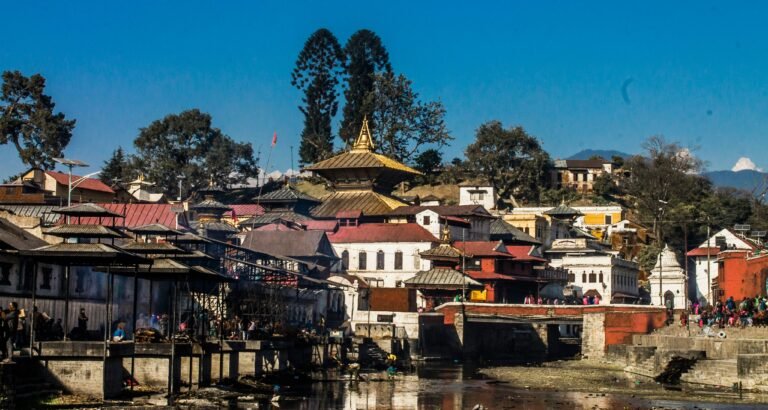
- Pashupatinath Temple: Nepal’s most sacred Hindu site, stretched along the banks of the Bagmati River. Non-Hindus cannot enter the main temple courtyard, but everything else is visible, including the open-air cremation ghats seen from the opposite bank, the forest hermitage of tiny Shiva shrines behind the temple, and the free evening aarti ceremony at the main ghat, which is open to all.
- Changu Narayan, the quiet seventh monument zone: a Vishnu temple on a ridge above Bhaktapur holding the oldest dated inscription in Nepal, a stone pillar raised by King Manadeva in 464 AD. A kneeling Garuda faces the sanctuary, and the surrounding courtyard reads like an open-air museum of Lichhavi-era carving. It is the least visited of the seven sites, which for many visitors is exactly its charm.
How the seven sites actually differ
Planning gets easier once you know what each site offers. The Durbar Squares are about royal display, woodcarving and museum collections; pace yourself for two hours at each, half a day in Bhaktapur. The two stupas are living pilgrimage circuits best experienced by walking around them rather than into them; budget one relaxed hour each. Pashupatinath is about ritual on a riverbank, with no monument to enter at all for most visitors; time your visit for late afternoon. Changu Narayan is a stone-carving gallery in a village setting, best paired with Nagarkot. Add a licensed guide at any of them and the carved struts and guardian statues start telling stories you would otherwise walk straight past.
Ticket prices: SAARC versus foreign visitors
There is no combined ticket, so each site charges separately. Fees are revised periodically, so treat the numbers below as indicative for 2026 and confirm at the counter.
| Site | Foreign visitors (NPR) | SAARC visitors (NPR) |
|---|---|---|
| Kathmandu Durbar Square | 1,000 | 250 |
| Patan Durbar Square | 1,000 | 250 |
| Bhaktapur Durbar Square | 1,800 | 500 |
| Swayambhunath | 200 | 50 |
| Boudhanath | 400 | 100 |
| Pashupatinath | 1,000 | Free for Indian and Nepali citizens |
| Changu Narayan | 300 | 100 |
- Nepali citizens enter free at most sites, and children under 10 are usually free everywhere.
- Tickets are generally valid only on the day of purchase. In Bhaktapur, showing a hotel booking receipt at the ticket office can extend validity for the length of your stay in town.
- Carry small notes. Card payment is rare at ticket counters.
- A licensed guide costs roughly USD 30-50 per day and is worth it at the Durbar Squares, where most of the value is in stories rather than facades.
Suggested heritage itineraries
One day: the classics
Start at Swayambhunath at opening time before the tour groups arrive, then head to Kathmandu Durbar Square and lunch in the old city. In the afternoon drive to Boudhanath for the kora, and finish at Pashupatinath for the evening aarti on the east bank. It is a full day, but all four stops sit on a sensible driving loop with a private car and driver.
Two days: squares and the ridge
Day 1 as above. On Day 2 drive out to Bhaktapur for the morning light and the pottery square, climb up to Changu Narayan after lunch, and end with a Himalayan sunset from the ridge town of Nagarkot before returning to the city.
Three days: the unhurried version
Day 1 covers the four classics. Day 2 belongs to Patan: the museum, the Golden Temple and the Mahabouddha courtyard, with a long Newari lunch, then Boudhanath again in the evening. Day 3 repeats the Bhaktapur, Changu Narayan and Nagarkot circuit. This pace leaves room for festivals, shopping and simply sitting in the squares, which is half the point of visiting.
The 2015 earthquake and the restoration story
The 2015 earthquake hit the Valley’s monuments harder than anywhere else in Nepal. Kathmandu Durbar Square lost several temples outright, including the Kasthamandap, whose community-funded reconstruction was later completed using traditional joinery. Bhaktapur lost the stone Vatsala Temple and saw the Fasidega Temple partially collapse. At Patan, heritage teams rebuilt the fallen Char Narayan Temple with as much salvaged original material as possible, a restoration praised internationally as a model of practice. Some scaffolding remains at a handful of structures, but every one of the seven monument zones is open, rewarding and safe to visit, and entry fees are a direct contribution to the ongoing work.
The Newari thread: one culture, seven masterpieces
Every one of the seven sites was designed and built by Newari craftsmen, whose guild system shaped the tiered pagoda style that later travelled as far as Japan. Look closely and the same vocabulary repeats everywhere: the carved wooden window called the aankhijhyal, the brick-and-timber frame engineered to flex in earthquakes, and the roof struts bearing gods and demons. We cover this engineering in depth in our piece on the wisdom of Newari architecture.
The culture is living, not just architectural. The Kumari of Kathmandu Durbar Square is a Newari girl from a Buddhist family, embodying a Hindu-Buddhist synthesis that defines the Valley; read about the current one in our article on the new Living Goddess of Nepal. And taste the thread as you go: juju dhau, the “king of curd”, in Bhaktapur; samay baji and yomari in Patan’s Newari restaurants; chatamari from street stalls in Kathmandu.
4. Full city tour
For a structured overview of all the key sites in one day, read the Kathmandu City Tour guide, which covers routing, entry fees, transport, and timing.
5. Nearby hikes and day trips
Short on time? The Top 5 Hikes Near Kathmandu guide covers Shivapuri, Champadevi, Nagarkot, and other half-day walks with valley views. For rock climbing, see Rock Climbing in Kathmandu.
6. All 7 UNESCO sites
For the complete national list with entry fees, opening hours, and transport details, see Nepal UNESCO World Heritage Sites Guide, which also covers Lumbini, Chitwan and Sagarmatha.
7. Culture and festivals
The Valley is the cultural heart of Nepal. Read the Nepal Festivals Guide for the major celebrations, Dashain, Tihar, Holi, Indra Jatra, many of which centre on the Durbar Squares. If your dates are flexible, aim for one of them: during Indra Jatra in September the chariots of the Kumari roll through Kathmandu Durbar Square, in April Bisket Jatra fills Bhaktapur with tug-of-war chariots, and in December Patan’s squares glow with yomari lanterns for Yomari Punhi.
Quick FAQ
How many days do I need for the Kathmandu Valley?
Two full days minimum: Day 1 for the three Durbar Squares, Day 2 for Boudhanath, Pashupatinath and Swayambhunath. Three days allows a relaxed pace and a day hike or a festival.
Is there a combined ticket?
No. Each site charges a separate entry fee (roughly NPR 200-1,800 for foreigners). SAARC nationals pay less, and Nepali citizens enter free at most sites. Tickets are valid for the day of purchase, with an extension possible in Bhaktapur if you stay overnight.
What is the best way to get around?
Hire a private car and driver for the day (USD 25-40), the most efficient way to cover multiple sites. Taxis are cheaper but require negotiation. Ride-sharing apps (Pathao, inDrive) work within the city.
What should I wear when visiting the temples?
Cover shoulders and knees at all religious sites. At Pashupatinath, modest dress is essential and non-Hindus should not attempt to enter the main sanctum. Remove shoes before entering any temple sanctuary or shrine room.
When are the sites least crowded?
Early morning, before 9 am, at every site. Kathmandu Durbar Square and Swayambhunath are busiest from late morning to mid-afternoon, and Boudhanath peaks around sunset, which is also when it is at its most atmospheric.
Share this content: