
Mardi Himal Is Nepal’s Busiest Short Trek — and High Camp Has Run Out of Beds
KATHMANDU, November 13, 2026 (27 Kartik 2083) — The highest cluster of lodges on the Mardi Himal trek has run out of beds. The Mardi Himal Trek Management Committee says 600 to 700 trekkers a day are now walking the route above Pokhara, and that every lodge above Forest Camp has been full, with the overflow sleeping in tents and dining halls.
“With all the lodges above Forest Camp fully occupied, there is no capacity to accommodate additional tourists,” Rajkumar Tamang, chairperson of the committee, told the Rastriya Samachar Samiti (RSS) news agency, in remarks published in English by Tourism Mail on November 12.
High Camp, the last place with beds before the 4,500 m base camp, has 14 lodges in operation. Under a rule agreed by the Annapurna Conservation Area Project (ACAP), Machhapuchhre Rural Municipality and local hoteliers, none of them may keep more than 25 beds — a ceiling of roughly 350 beds for a trail that is now absorbing several hundred walkers a day.
Key facts
- The Mardi Himal Trek Management Committee puts current traffic at 600–700 trekkers a day, up sharply on previous years, with the surge beginning in Asoj (mid-September to mid-October).
- Fourteen lodges operate at High Camp. Each is capped at 25 beds under a tripartite agreement between ACAP, Machhapuchhre Rural Municipality and hoteliers reached in September 2025.
- When beds ran out this season, visitors were put in tents and dining halls, according to the committee chair.
- The trek is a three- to four-day round trip from Ghalel, Kalimati or Siding in Machhapuchhre Rural Municipality, or from Kande in Annapurna Rural Municipality.
- No official arrival figures for the route have been published. The daily count is the committee’s own estimate and is not broken down by nationality.
Fourteen lodges, twenty-five beds, and no way to build
The bed ceiling is not an accident of construction. It is a conservation decision, and it is the reason this season’s crowd has nowhere to spill.
In September 2025, a joint team from Machhapuchhre Rural Municipality, ACAP and the local hotel committee agreed that no hotel on the Mardi route would operate more than 25 beds. Excess beds were sealed. New hotels were ruled out, and two-storey buildings were restricted to one floor in use. Ten tea shops at the viewpoint were consolidated into a single operation. At the time, 70 hotels and tea shops were running along the trail.
“Hotels opened haphazardly. It affected the forest area and the environment. We could not simply tell them not to build,” Dr Rabin Kadaria, a director at ACAP, told Ratopati at the time. “The worry that it would get worse led us to set a fixed quota. Its main purpose is tourism management.”
That logic has held. What has changed is the volume of people arriving at the top of it. Fourteen lodges at 25 beds each come to about 350 beds at High Camp, and there is no lodging between there and the base camp.
Why Mardi, and why this year
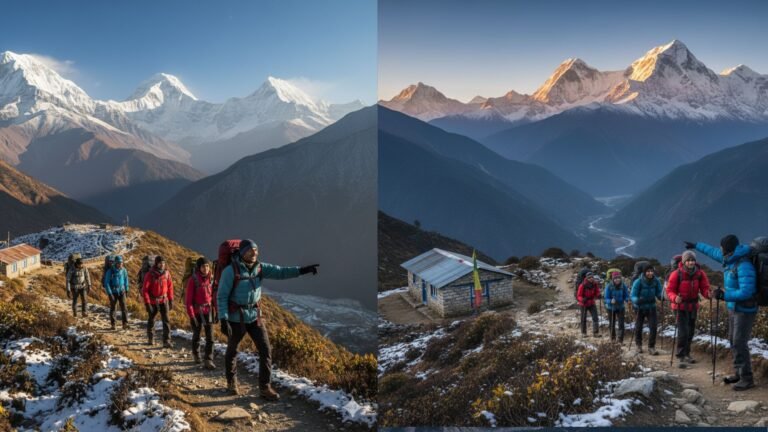
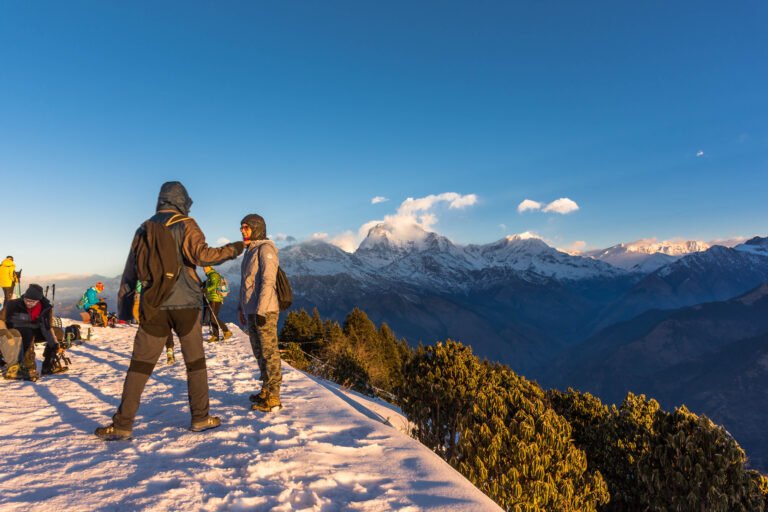
Mardi Himal sells something the bigger routes cannot: a Himalayan ridge, 13 peaks in one sweep including Machhapuchhre, Annapurna South and Hiunchuli, and a base camp reached in three or four days from a road head an hour from Pokhara.
Those are precisely the qualities that made it the obvious choice this autumn. The Dashain–Tihar holidays put a large domestic travelling population on the move, the weather held, and the trailhead is close enough that no flight and no long highway transfer is required. The committee says the rush began in Asoj and never really eased.
The timing sits against a difficult season elsewhere. Floods on August 26 cut the Langtang approach and pushed that trek’s start from Syabrubesi back to Dhunche; heavy September snow closed the Manaslu season and disrupted Dhaulagiri; several highway corridors in the hills were blocked for days at a time. None of that is a direct cause of Mardi’s numbers — the committee does not say it is — but it helps explain where the short-haul demand went.
The official position: manage it, do not expand it
Neither ACAP nor Machhapuchhre Rural Municipality has proposed raising the bed cap in response to this season’s crowds. The committee’s public position is that the answer lies in trail upgrading, waste management, cleanliness, a working visitor information system and better security arrangements — the list of demands local operators have repeated for years.
Tamang’s stated worry is reputational. A trekker who pays for a room and sleeps in a dining hall tells other people, and Mardi’s rise has been built almost entirely on word of mouth. “I worry that inconvenience to visitors will send a negative message about Mardi,” he said, according to RSS.
There is also a structural point buried in the arrangement: the cap is enforced by sealing beds, not by limiting the number of people who may enter. Trekking permits are issued without a daily quota on this route, so the crowd is regulated only indirectly — by how uncomfortable the top of the trail becomes.
What it means for trekkers
If your dates fall in a festival week or the second half of October, treat High Camp as a booked resource, not a walk-in.
- Book the High Camp bed before you start walking. Lodges take bookings by phone, and guides and agencies routinely hold rooms days ahead. A confirmed bed should be confirmed in writing, with the lodge named.
- Arrive early. Walk-in trekkers who reach High Camp by early afternoon have a far better chance than those arriving at dusk. Groups coming up from Forest Camp in one long day are the ones most likely to be squeezed.
- Know your fallback. Badal Danda and Low Camp have more beds. Sleeping low and starting the summit morning before first light is a longer but reliable plan, and it is the standard workaround when High Camp is full.
- Carry a sleeping bag rated for below freezing. Dining-hall floors and tents are cold at 3,580 m, and blankets are not a substitute in November.
- Budget the permits. The route sits inside the Annapurna Conservation Area: ACAP entry is NPR 3,000 for foreign visitors plus a TIMS card at about NPR 2,000. Carry rupees; there is no card machine at the checkpoints. Details are in our visas and permits guide.
- Do not plan a tight exit. The descent to Siding and the jeep back to Pokhara can absorb a whole afternoon, and a delayed summit morning cascades into a missed connection.
What it means for operators
The days of promising “a room at High Camp” as a loose intention are over on this route. Agencies selling Mardi for the rest of November should hold rooms in writing, name the lodge, and build the itinerary so that a night at Badal Danda is a plan rather than a rescue. Groups should also be told, before they pay, that the highest night may be shared accommodation and that facilities above Low Camp are basic by design — no electric heating, shared bathrooms, paid charging.
The weather window is closing anyway
The crowd problem is about to solve itself the hard way. The Department of Hydrology and Meteorology said on Friday that Nepal is under the partial influence of western winds, with fog in the valleys and mainly clear conditions elsewhere, and warned of the possibility of light rain and snowfall at a few places in the Himalayan and hilly districts of Gandaki, Koshi and Bagmati.
That is the pattern for the rest of November: clear mornings, a chance of snow on the ridge, and a High Camp that gets colder every week. From late November snow is routine on the ridge. The window for a comfortable Mardi trek this year is roughly the next two to three weeks; after that it is a winter trek with microspikes and a much thinner safety margin.
For anyone holding a booking in the next fortnight, the practical order of operations is simple: confirm the bed, arrive early, keep a day of slack, and check the forecast the morning you climb.
What is not established
There is no official count of arrivals on the Mardi route. ACAP and the rural municipality have not published season totals, and the 600–700 figure is the trek management committee’s estimate of daily traffic across the whole trail, not a checkpoint count. No breakdown by nationality has been released, so it is not possible to say how much of the surge is domestic holiday travel and how much is foreign bookings — though the timing, at the end of the Dashain–Tihar holidays, points strongly to a domestic spike. Reports also differ on High Camp’s altitude, with agencies listing about 3,580 m and local reporting nearer 3,700 m; the lodges sit somewhere in that band.
Sources: Tourism Mail, Rastriya Samachar Samiti (via Bizmandu, Radiovision, Maitri News and Sourya Online), Ratopati, Department of Hydrology and Meteorology via Nepal News.
Share this content: