Rupa Lake Is Getting a Rs 4.53 Billion Makeover. The Temple Island Comes Later
KATHMANDU, November 14, 2026 (28 Kartik 2083) — Rupa Lake, the third-largest of the lakes in the Pokhara valley, is being rebuilt from the water up. A 590-metre earthen embankment and a 45-metre concrete section are closing its outflow stream, the lake itself is meant to spread from 122 hectares to 183, and a temple modelled on Phewa’s Tal Barahi is planned on a platform standing in the middle of the water. The budget is Rs 4.53 billion. The opening date is not this year, and not next.
Key facts
- Cost: Rs 4.5288 billion, executed under the Irrigation and Water Resources Management Project, Pokhara.
- Size change: 122 hectares today, 183 hectares once the dam holds; average depth from about 3 metres to about 7.
- Structure: 590 metres of earthen dam plus 45 metres of concrete, six metres high, up to 45 metres wide at the crest.
- Planned attractions: temple island on pillars sunk 12 metres into the lake bed, park on the dam crest, west-shore walkway with a cycling lane, beach volleyball court.
- Already built: an eight-kilometre road along the eastern shore.
- Timeline: originally due in the 2024/25 fiscal year, already missed; the project office now says another two years; the approved master plan targets 2085/86 BS (2028-29).
- Unresolved: forest land use and tree-felling approval, and two different shoreline boundaries, 100 metres on the Pokhara side and 50 metres on the Rupa side.
A lake with a master plan attached
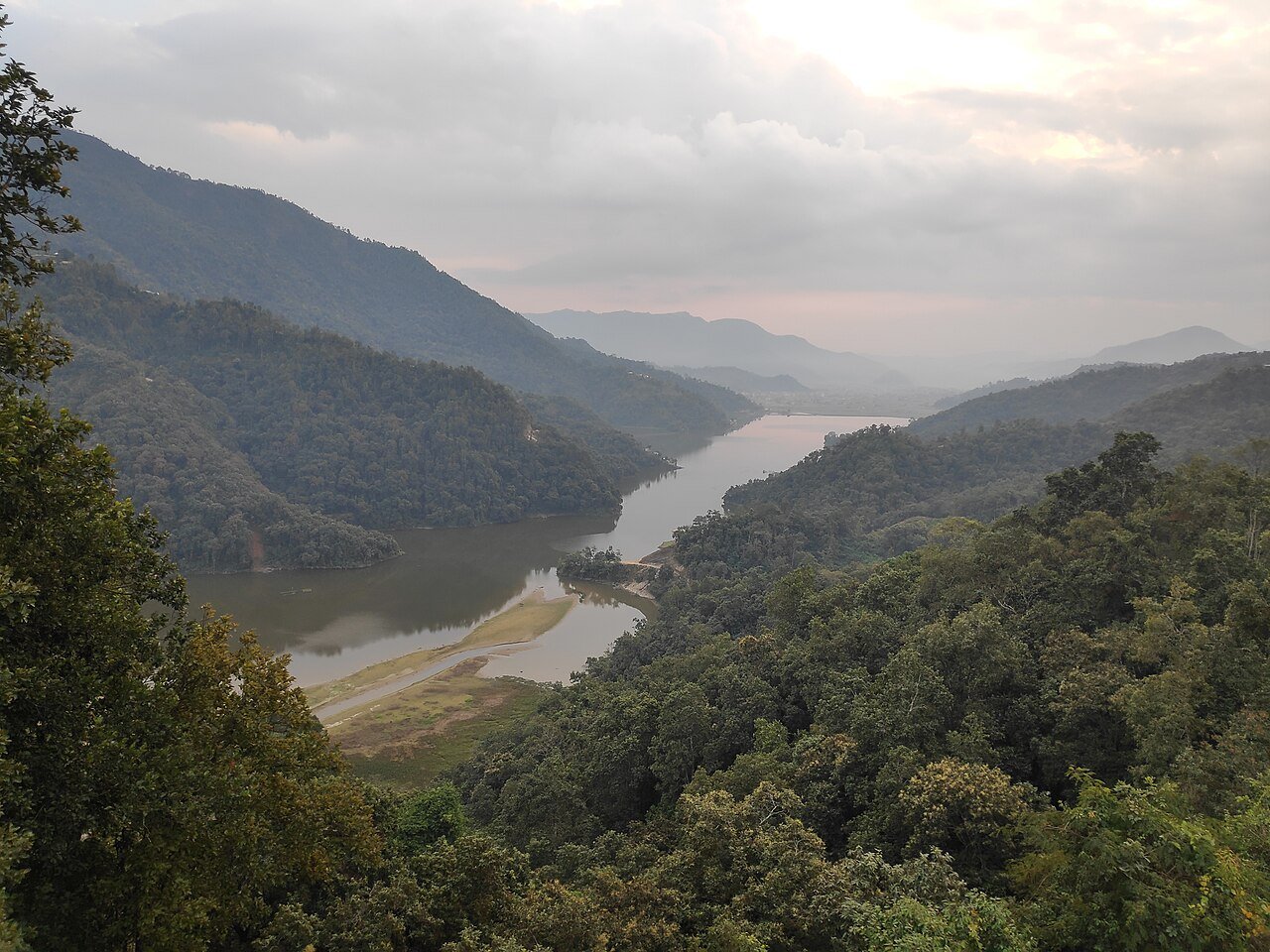
Rupa sits on the boundary between Pokhara Metropolitan City and Rupa Rural Municipality, east of the city and next to Begnas. It is the quiet one of the valley’s lakes: reeds, fish cages, a shoreline of terraced fields, and mountains to the north that show up in the water on clear mornings. That quiet is the raw material of the project.
According to the project office, the dam will hold the water level steady rather than letting it fall through the dry months, and the raised surface will swallow the mudflats that have been colonised by weeds. On the crest of the widest section, a park. On the western shore, where the forest comes down to the water, a walkway with a dedicated cycling lane. On the lake bed itself, pillars rising 12 metres to carry a platform with a temple and garden, reached by a footbridge, in the same idiom as Phewa’s island shrine. There is even a beach volleyball court in the plan.
Following the money
The Rs 4.5288 billion figure is the project’s total cost. Reporting from Sourya Online in April put Rs 2.70 billion of work already done against the same Rs 4.52 billion envelope, a figure earlier reports also used. Within that, the dam is the most expensive single contract: Rs 290 million to Kalika Naya Bato JV, with a completion date of Bhadra 23, 2083 — early September 2026 — that has passed.
Silt removal is the other big line: around 800,000 cubic metres of sediment dug out of the lake bed, contracted to Uma and Company at about Rs 400 million with a deadline of Falgun 20. Land for the perimeter road and walkway has taken much of the rest — roughly 1,100 ropani needed, about 900 acquired at the last ministerial inspection, with compensation disputes still live.
Why “70 per cent” needs a footnote
The progress figure published this week is easy to misread. Rising Nepal’s report quotes engineer Narajung Gurung of the project office saying around 70 per cent of the project work is complete. Reporting in April, however, attributed the same 70 per cent specifically to the dam, not to the project as a whole, and put the master plan’s full completion at 2085/86 BS.
Both can be true. The dam is well advanced. The temple island, the park, the walkway, the cycling lane and the volleyball court are drawings. The lake bed still has most of its silt. So the honest reading is that the civil works that stabilise the water are nearly done, while the works that would make Rupa a destination have barely started, and the project office has not published a single consolidated progress figure that separates the two.
Two years late, and two more to go
The original completion target was the 2024/25 fiscal year, which ended in mid-July 2025. Project chief Bidurman Shrestha now says another two years are needed. That points at 2028, which lines up with the master plan’s 2085/86 BS target — the two dates are consistent with each other, and both are a long way from the promise.
The reasons are ordinary and stubborn. Compensation for land taken along the shoreline has been contested for years, and at one point local residents stopped construction outright over plots that had been frozen for acquisition without payment. Silt removal depends on the monsoon letting machines into the lake bed. And the approvals to cut trees and use forest land have not been settled, which is the constraint that matters most for the part of the plan tourists would actually use.
The forest clearance that has not come
The western shore is forest. The walkway and cycling lane run through it, and until the tree-felling and forest-land approvals are granted, that section cannot be built. Rising Nepal’s report states the issue plainly: the problems related to felling trees and using forest land required for the project remain unresolved.
This is the difference between a lake with a dam and a lake with an experience. The dam is engineering with a contractor and a deadline. A 3.6-kilometre lake with a walkway, a cycling loop and a temple island needs land tenure, forest clearance, a bridge design and a maintenance budget. None of those has been publicly settled.
One lake, two boundaries
Rupa has an unusual administrative problem: two local governments share it. Pokhara Metropolitan City enforces a 100-metre shoreline boundary on its side. Rupa Rural Municipality enforces 50 metres on its side. The lake is about to get bigger, which means the boundary line determines whose house is inside the new high-water mark.
On the current 50-metre standard, four or five houses would need to be relocated. The chair of Rupa Rural Municipality, Navaraj Ojha, says the two authorities are trying to harmonise the standards so that residents benefit as much as possible from the project. Until they do, the relocation list — and the compensation bill attached to it — stays provisional, and a household that is safe under one rule is exposed under the other.
What it means for travellers
Rupa is worth a morning now, but not for the reasons the project is being built. The birding is the draw: the irrigation department counts more than 36 species of water-dependent birds using the lake, and the mix of open water, reed bed and paddy around it makes it the best quiet alternative to Phewa in the valley. It is also a working fishery: the Rupa Lake Restoration and Fish Farming Cooperative has 1,154 shareholders and sold Rs 14 million of fish last year. Combine it with Begnas, which is next door.
Practical points for this season:
- Do not plan around the temple. It is a design on a platform that does not exist yet. Nobody has published a construction date, a cost or an opening.
- Expect construction traffic on the east road. The eight-kilometre shore road is finished, but dam and silt machinery still uses the same approach.
- Ask before walking the west shore. The forest section is where the walkway is planned and where clearance is missing; access rules are local and change with the work front.
- Go early. Birds are the reason to come, and the valley wind picks up late morning.
- Operators should not sell Rupa as a 2027 attraction. If you are packaging it, sell birding and a fish lunch, and confirm with the project office before promising a lakeside walk.
What remains unconfirmed
The lake’s present area is reported as 122 hectares this week and in April, but older project reporting used 107 hectares and one recent government release 1.35 square kilometres. The dam length has appeared as 572 metres and as 590. Silt volume has been given as 800,000 and 900,000 cubic metres. The depth increase, from three metres to seven, is consistent across reports.
There is no announced completion date, no contract award for the temple island and no published cost for the landscaping and park on top of the Rs 4.53 billion. The relocation of four or five houses depends on a boundary decision that has not been made. And the 70 per cent figure, as published, does not say what it is 70 per cent of.
Sources: The Rising Nepal (Phadindra Adhikari, Kaski, 14 November), Sourya Online, Naya Bikalpa, Saharsha News, Ratopati, and the Irrigation and Water Resources Management Project, Pokhara.
Related reading on travellingnepal.com: the Pokhara travel hub, the Annapurna region guide, and Start Here for permits and trip planning.
Featured photo: Rupa Lake, Kaski. Photo: Gaurav Dhwaj Khadka / Wikimedia Commons, CC BY-SA 4.0
Share this content: