Nepal Now: Fonepay Opens Its QR Network to Foreign Visitors
KATHMANDU, November 27, 2026 (11 Mangsir 2083) — A foreign visitor in Nepal can now pay a Thamel shopkeeper, a Lakeside café in Pokhara or a Kathmandu taxi by QR code without opening a Nepali bank account. Fonepay, which describes itself as Nepal’s largest payment network, and Nabil Bank announced Nepal Now on Thursday: an app that loads a prepaid card from an overseas Visa, Mastercard or UnionPay card and spends it in rupees at Fonepay tills.
The launch closes a gap that has annoyed visitors for years. Nepal’s QR network reaches deep into everyday retail, but its consumer wallets were built for citizens, leaving tourists with cash, cards accepted at bigger hotels, and a queue at the ATM.
Key facts
- Nepal Now is a Fonepay and Nabil Bank app for international visitors, announced in Kathmandu on Thursday, 26 November.
- Registration requires a valid passport and a Nepal visa, and is limited to users aged 18 and over who are physically in the country.
- Money is loaded from a foreign Visa, Mastercard or UnionPay card onto a prepaid card issued by the partner bank; payment is by scanning a Fonepay QR code.
- Fonepay’s announcement put the network at more than two million QR merchant locations; its own website says 1.7 million and its App Store listing says 1.9 million.
- No fee schedule or transaction limit for the app has been published; the terms leave both to the partner bank and the app.
- Accounts are suspended when the visa on record expires, and unused balances are refunded through the partner bank rather than the app.
What was announced
The app comes from Fonepay Payment Service Limited, which holds a payment system operator licence from Nepal Rastra Bank, and from Nabil Bank, which issues the prepaid card and runs the identity checks. It is listed on the App Store and Google Play.
Fonepay says it connects more than 60 banks, wallets and other partners, with over 20 million registered customers, on a QR standard that is EMV compliant. Those rails were effectively closed to anyone without a Nepali bank account, a Nepali mobile number and citizenship documents for KYC — which is to say, to every visitor.
How a visitor sets it up
The order of operations matters, and it is where most people will stumble.
- Arrive first. Registration asks for passport details and a valid Nepal visa, so it cannot be done in a departure lounge. The terms require the user to be physically present in Nepal and say the app may verify location. The visa itself is covered in our visas and permits guide.
- Register and verify. The partner bank runs KYC on the passport and visa, then issues a prepaid card. You need a phone that can receive a one-time password and a data connection.
- Load a little. Funding is by international Visa, Mastercard or UnionPay; American Express is not on the list.
- Scan and pay. The merchant is settled in rupees through Fonepay and your balance falls.
- Empty the card before you fly. Remaining balances can be refunded through the partner bank, and the account freezes automatically at visa expiry. It can be reactivated on a later trip.
Why it matters more than it sounds
Nepal’s visitor economy runs on small transactions: a plate of dal bhat, a taxi to Patan, a porter’s tip, an extra lodge night. Those are cash moments, and they are exactly where foreign cards fail. Hotels in Kathmandu and Pokhara take cards; a spice seller in Asan, a bus conductor on the Prithvi Highway and most teahouses above 3,000 metres do not. Visitors have compensated by carrying more cash than they would like and paying a fee at every ATM withdrawal, and a large share of tourist spending has stayed outside the formal payment system — the part of the problem Fonepay is actually selling against.
On the trail, expect the change to be slow. QR acceptance thins out quickly above the road heads, and the Khumbu, Annapurna and Manaslu routes remain cash economies for lodge bills as well as hot showers. Our Everest region hub and Pokhara guide both assume you are carrying rupees.
The numbers do not agree
Three merchant counts are in circulation, all of them the company’s own. The launch statement carried by the Kathmandu Post says more than two million Fonepay QR merchant locations; Nepali-language coverage repeats 20 lakh, the same figure. Fonepay’s About page says 1.7 million merchants; the App Store description of Nepal Now claims more than 1.9 million.
A spread of 300,000 shops between a company’s own outlets is not a rounding error, and none of the three is independently audited. The direction is not in doubt — Fonepay QR reaches neighbourhood groceries well beyond the tourist districts — but the precise count should be read as marketing until the company reconciles it.
What the terms leave open
Fees are the biggest gap. The terms say users agree to pay any service charges, card issuance fees or transaction fees defined by the partner bank and Nepal Now, and that Nepal Now may revise them with notice in the app. No schedule has been published. Fonepay’s own fee schedule, effective 17 July 2025, lists QR payments at merchant outlets as free, but adds that the charges fall on member banks and that customers should ask their bank — an answer about the network, not about what a visitor pays to load or convert.
Conversion is the second unknown. The terms say top-ups through international networks may carry the exchange rate and conversion fee set by the issuing bank or card network, that rates move, and that Fonepay does not control them. A wallet that saves you a visit to the money changer can still be the dearer way to buy rupees.
Disputes are the third. Refunds and card disputes are handled by the partner bank under cardholder policy and Nepal Rastra Bank grievance rules; the app says it can pass messages but cannot reverse, hold or alter a refund. Limits are referred to as daily, weekly, monthly and annual, and quantified nowhere public.
Two exclusions sit in the terms rather than the marketing. Nabil describes the service as being for foreign tourists other than Indian, without explaining how Indian nationals should pay by QR — the likely reason is that Fonepay has run a separate UPI cross-border programme since 2023. And the card is personal: one traveller cannot fund a group of four.
The official position
Diwas Kumar, Fonepay’s chief executive, presented the app as an extension of infrastructure Nepal already has. “Nepal has built an extensive QR payment network, and we see an opportunity to make that infrastructure accessible to visitors from around the world,” he said, according to the Kathmandu Post, adding that the aim was simpler daily payments for travellers and more international customers for local merchants. Nabil lists the expected gains as convenience and safety for tourists, higher spending in hotels, restaurants, transport and retail, and a stronger digital base for tourism. Those are expectations. The app is days old.
What it means for travellers and operators
For visitors, the sensible posture is curiosity plus a cash reserve. Set the app up after immigration, load a modest amount and watch what the top-up actually costs before committing more. Keep rupees for the trail — teahouses, porters and jeep drivers on mountain roads are cash businesses — and clear the balance before departure, because a refund runs through the bank and a visa expiry freezes the account. If you extend your visa, expect to reactivate.
For a shop, café or lodge already displaying a Fonepay QR, nothing changes technically: the tourist is another payer on the same rail. The work is at the counter, making sure staff know a foreign card settles as normal and that the customer may want a receipt in English. Trekking agencies and hotels can now quote add-ons and upgrades digitally, but with limits unpublished they should not assume a client can settle a full trek balance this way.
What to watch
Three things will decide whether Nepal Now matters beyond its launch week: whether fees are disclosed, whether acceptance holds in Pokhara, Chitwan, Lumbini and the trail towns where visitors actually spend, and whether Nabil stays the only issuing bank. A single partner is a single point of failure at a weekend. The rest of the arrival logistics are in our start here guide.
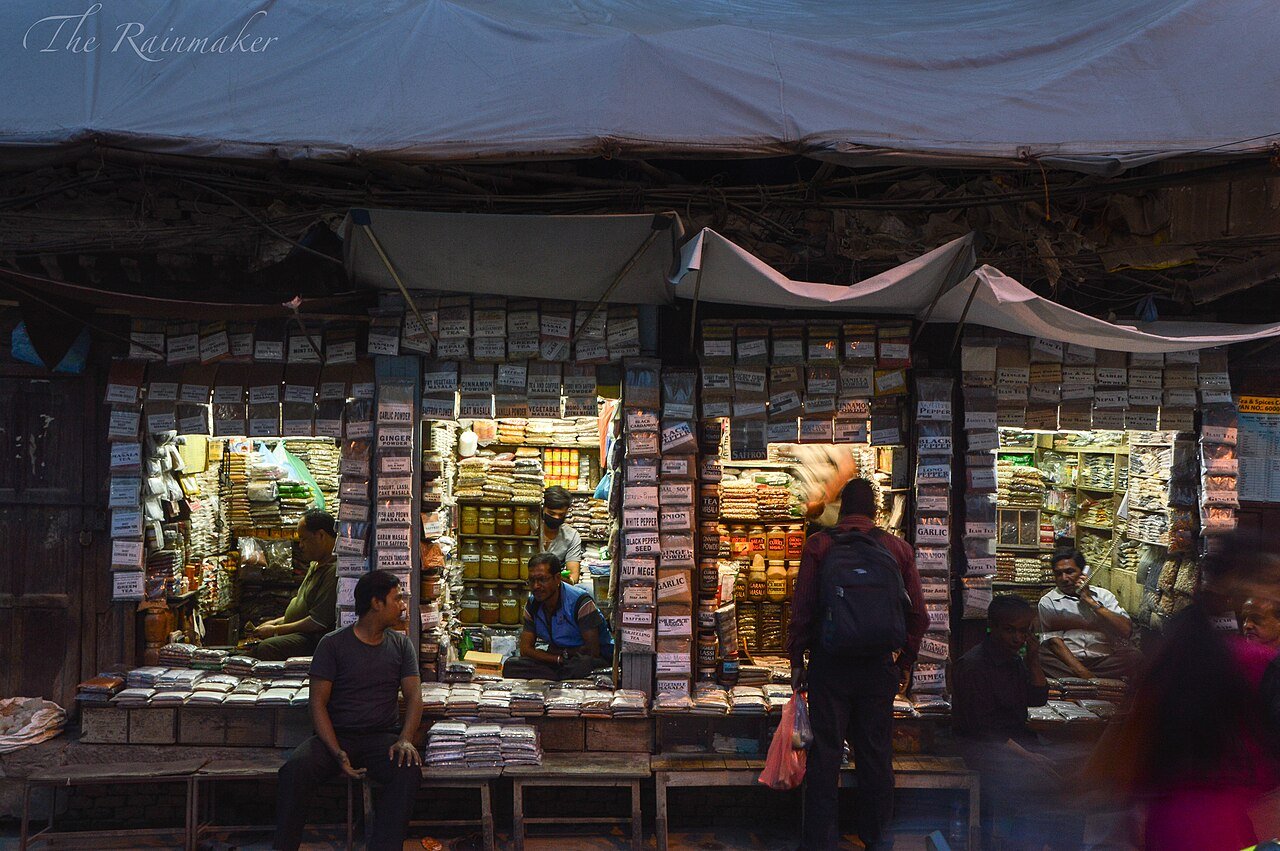
Featured image: shops in the Asan bazaar, Kathmandu. Photo: Dr. Nishant Bhatt / Wikimedia Commons, CC BY-SA 4.0.
Sources: Kathmandu Post, Shilapatra, Ajako Artha, Nepali Telecom, Fonepay, Nabil Bank.
Share this content: