Three Foreign Trekkers Died in Nepal’s Everest Region in Eight Days
KATHMANDU, November 25, 2026 (9 Mangsir 2083) — Three foreign trekkers died in Nepal’s Everest region in eight days this month, the last of them an American climber found dead in his tent at about 5,800 metres a day after reaching the summit of Mera Peak. Police in Solukhumbu have confirmed all three deaths. In none of the cases has a cause been established; post-mortems are pending or incomplete.
- Richard Carlos Skidmore, 66, of the United States, was found dead in his tent at Mera Peak high camp on Sunday, November 22, a day after summiting the 6,476-metre peak.
- Liew Shuik Chin, 59, of Singapore, died on November 15 on the trek to Everest base camp after becoming unwell at the camp and collapsing while being taken down.
- Anjunath K V, 31, from Kerala in India, was found dead in his hotel room at Gorakshep (5,164 metres) on Thursday, November 19. Police said he had no guide and no trekking agency.
- Nepal requires foreign trekkers in national parks and conservation areas to hire a licensed guide and book through a registered agency.
- The three deaths came as the autumn trekking and climbing season closed and visitor numbers in the Khumbu fell sharply.
- No cause has been officially established in any of the three cases.
Mera Peak: a summit at 10am, a night at 5,800 metres, and a body in a tent
Solukhumbu police said Richard Carlos Skidmore, 66, reached the top of Mera Peak (6,476 metres) at about 10am on Saturday, November 21. He then descended to the high camp at roughly 5,800 metres and stayed there overnight on his way down towards Khare, the last village on the approach. He was found dead in his tent on Sunday morning.
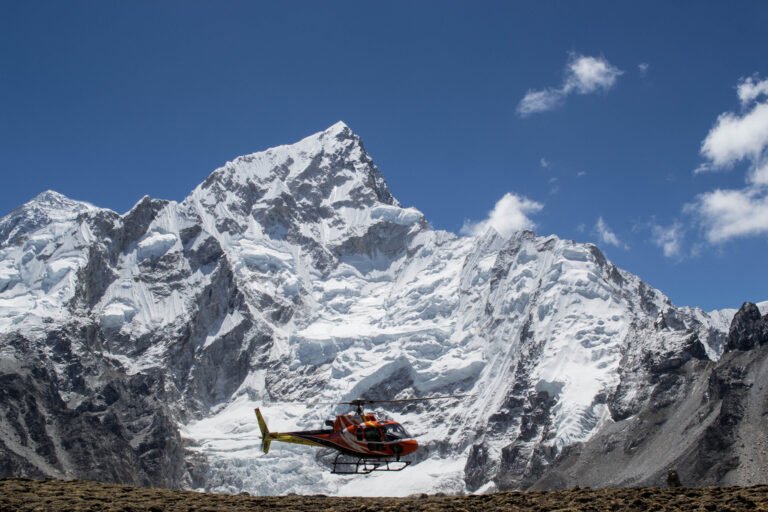
His body was flown by an Altitude Air helicopter to Lukla for legal procedures, then taken to Tribhuvan University Teaching Hospital in Kathmandu for a post-mortem, according to Everest Chronicle and The Himalayan Times. Police said the cause would be established only after the examination.
The Tourism Times quoted police as saying he may have suffered a heart attack following altitude sickness, while stressing that the autopsy would decide. Explorersweb reported that an initial account raised the possibility of altitude illness or a cardiac event, and that neither had been established medically.
Skidmore was not a novice. The Himalayan Database, cited by Explorersweb, records a Lobuche Peak summit in 2024, and the same database lists four other deaths on Mera since 2018. Past Mera climbers quoted by Explorersweb said on social media that spending the night at the high camp after summiting so early in the day was unusual, since most parties return to Khare. Police have not said whether Skidmore was climbing with a guide or through an agency.
Mera is one of Nepal’s trekking peaks: a glaciated but largely non-technical summit that many people use as a first 6,000-metre climb. The usual approach runs from Lukla through the Hinku valley and over the Zatrwa La to Khare, then to base camp and the high camp.
The Everest base camp trail: a Singaporean who died on the way down
Liew Shuik Chin, 59, died on November 15 on the trek to Everest base camp, which tops out at about 5,364 metres. According to The Straits Times, he became unwell after reaching the camp and collapsed while being taken to a lower altitude by others, and efforts to revive him failed. Some Singapore outlets initially gave his age as 60.
The first accounts came from a Facebook travel group, Adventure Village, and from The Tourism Times, a Nepali travel publication; Solukhumbu police later confirmed the sequence to The Tourism Times. His body was returned to Singapore.
His youngest sister, who gave her name as Trissie, told The Straits Times that he had been planning the trip since 2025 and had trekked the Annapurna Circuit in 2024. “Everest was something on his bucket list,” she said. “I guess he picked his place.” The newspaper said it had contacted Singapore’s Ministry of Foreign Affairs, the Nepal Tourism Board and a travel agency, Adventures Unlimited, for comment.
Gorakshep: a trekker who was on his own
Anjunath K V, 31, from Kerala in southern India, was found dead in his hotel room at Gorakshep on Thursday, November 19, Lukla police said. Gorakshep, at 5,164 metres, is the last settlement before Everest base camp.
Police said he had been travelling alone, without a guide or a trekking agency, and held only an entry ticket to Sagarmatha National Park. With no agency or emergency contact in Nepal, police worked with the Indian embassy to arrange the transfer of his body, which was flown by helicopter to Tribhuvan University Teaching Hospital in Kathmandu on Friday morning.
Kerala outlets Mathrubhumi and Kerala Kaumudi reported that acute mountain sickness was suspected. Police said the cause would be established after the autopsy. Everest Chronicle noted that many trekkers sleep lower, at Lobuche (4,940 metres), rather than at Gorakshep, and that anyone showing symptoms of altitude sickness is generally advised to descend to Lobuche or Pheriche.
The rule that solo trekking runs into
Since 2023, foreign trekkers in Nepal’s national parks and conservation areas have been required to hire a licensed guide and arrange their trip through a registered trekking agency, a change that ended independent solo trekking on routes including the Everest base camp trail. In March this year the Department of Immigration began allowing individual foreign trekkers to apply for restricted-area permits, but the guide and agency requirement stayed.
The paperwork for the Khumbu is layered: a Sagarmatha National Park entry fee of NPR 3,000, a Khumbu Pasang Lhamu rural municipality charge of about NPR 2,000 and a TIMS card at NPR 2,000, with a licensed guide required on top. A full breakdown sits in our visas and permits guide.
Police said the Indian trekker held only the park ticket. That detail matters beyond the paperwork: an agency is the entity that holds an itinerary, knows where a client is supposed to be and is the first call when something goes wrong.
What the three deaths do and do not show
There is no public consolidated count of deaths in the Khumbu this autumn. Each case has been released separately by district police, and the three have little in common beyond the region and the timing: a 66-year-old American on a 6,476-metre trekking peak, a 59-year-old Singaporean on the base camp trail and a 31-year-old Indian travelling alone at 5,164 metres. Nothing published so far points to a shared cause, a single operator or a single route.
What the timing does illustrate is the margin at the end of the season. The autumn climbing and trekking season is closing, visitor numbers in the Khumbu are falling sharply and services thin out with them, a point we made in our report on the season handover.
The data gap is not new. In a position paper dated September 2026, the International Climbing and Mountaineering Federation, the International Commission for Alpine Rescue and the International Federation of Mountain Guides Associations called for systematic reporting and analysis of climbing accidents, arguing that causes are usually an interplay of factors that cannot be identified case by case. In Nepal, incident information is generally released case by case by district police rather than through a published national database.
What it means for travellers and operators
- Book through a registered agency, not just a guide. The agency is who police, insurers and embassies contact.
- Read the altitude ceiling on your insurance before you fly to Lukla. Check that helicopter evacuation is included and that the policy covers the highest point you intend to reach.
- Sleep lower when symptoms appear. On the base camp route that can mean Lobuche instead of Gorakshep; the rule of thumb is to descend rather than wait.
- Treat Mera high camp as a launch pad, not a hotel. The standard pattern is to climb from high camp and return to Khare the same day, which is what experienced Mera climbers flagged about this case.
- Build a weather and rescue margin late in the season. Fewer flights, fewer helicopters and thinner staffing are normal in late November; plan an extra day rather than a same-day connection.
- Operators should file itineraries, nominate an emergency contact for every client and report incidents even when they end well.
Planning for the region, including acclimatisation and route timing, is in our Everest region guide.
What is still unknown
Autopsy findings in all three cases. Whether Skidmore was climbing with a guide or an agency. Exactly where on the descent Liew collapsed. Whether the Indian trekker’s death was altitude-related. Police have declined to speculate beyond what the examinations show, and this article will be updated if the Department of Tourism, the Nepal Tourism Board or district police publish findings.
Sources: The Himalayan Times, Everest Chronicle, Explorersweb, The Straits Times (via Asia News Network), The Tourism Times, Mathrubhumi, Mothership
Share this content: