Pheriche Collision Exposes Khumbu’s Helicopter Oversight Gap — and a Report Nobody Implemented
KATHMANDU, November 4, 2026 — Tuesday’s collision at the Pheriche helipad killed one passenger and injured three people in clear weather, at a pad both crews knew, in a valley where helicopters fly every morning of the trekking season. That is what makes it a regulatory story as much as an accident story.
Around 70 percent of Nepal’s private helicopter business is concentrated in the Khumbu region, according to reporting by OnlineKhabar, with a further 10 percent generated by Simikot–Hilsa operations in the far west. Dozens of helicopter flights take place daily above Lukla. And yet the area where most of the industry earns its money has almost no regulatory presence on the ground.
Where the tower cannot see
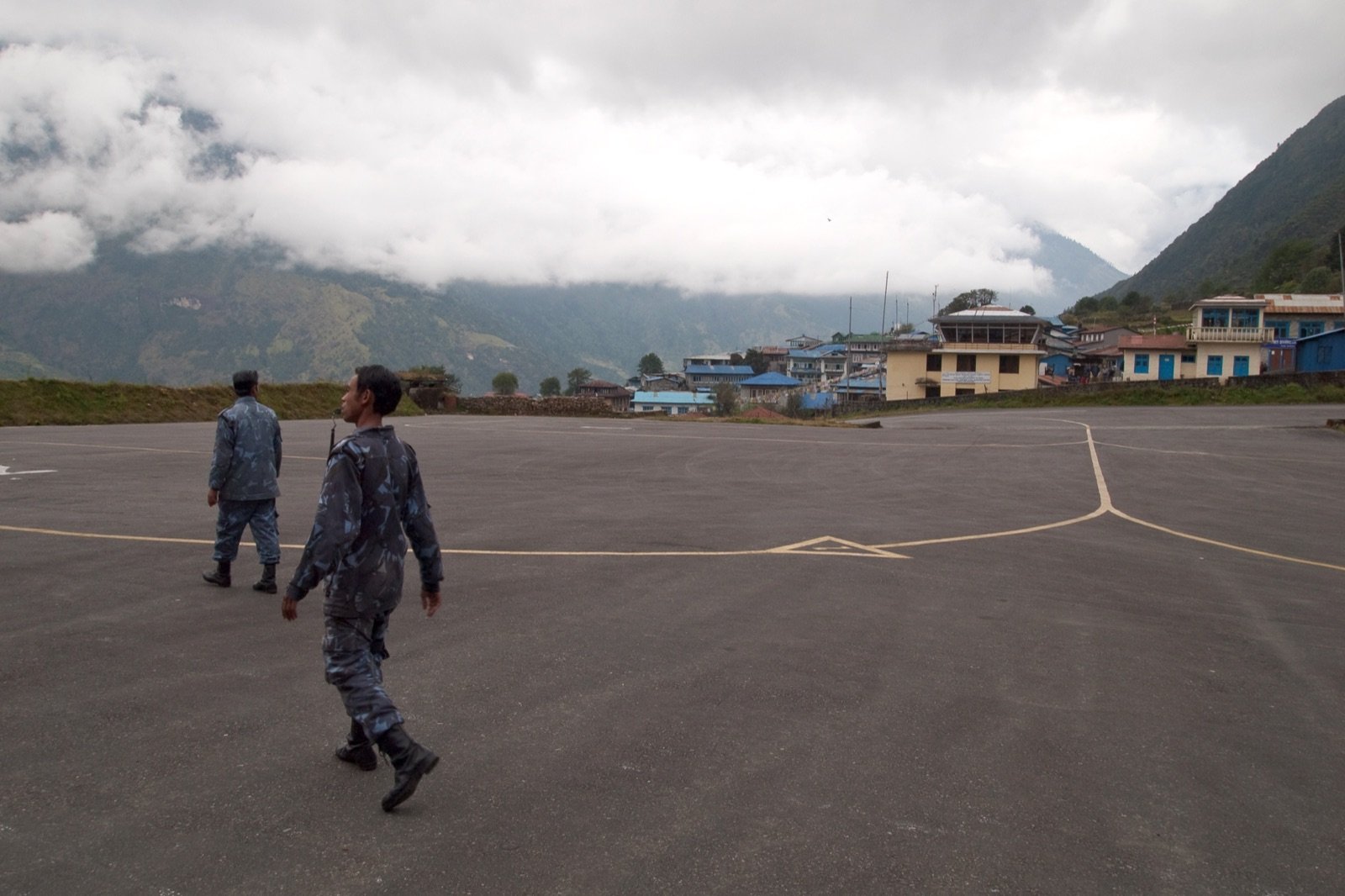
Lukla’s air traffic control tower is the aviation authority’s fixed point in the region. Its radio coverage does not extend to the helipads above it. Helicopters working Pheriche, Gorakshep, Kala Patthar and the surrounding pads coordinate directly with one another, and separation depends on each pilot in command maintaining situational awareness and agreeing a landing sequence by radio.
That is workable in principle — it is how uncontrolled aerodromes operate around the world. It depends on discipline, standard phraseology, and a shared understanding of who lands first. When it fails, there is no controller to catch the error, and, as Tuesday showed, a few seconds of disagreement at low altitude is enough.
CAAN personnel are not stationed at these remote pads. Technical assessment of helipad conditions, obstructions and operational risk is limited, and the authority does not routinely publish the assessments it does carry out. In practice, a large share of the safety burden sits with the operators and the pilots themselves.
A senior CAAN official told the Kathmandu Post that Pheriche’s pad can accommodate six or seven helicopters at a time — capacity is not the constraint. The question is sequencing.
The record behind Tuesday
Nepal has recorded at least 43 helicopter crashes since 1979, 23 of them fatal, according to Kathmandu Post figures. Eight have occurred in the Everest region, five of them involving fatalities.
- July 2023: a Manang Air helicopter crashed in the Lamjura area of Solukhumbu, killing all six aboard — five Mexican tourists from one family and Nepali captain Chet Bahadur Gurung.
- October 29, 2025: an Altitude Air helicopter crashed at Lobuche in Solukhumbu. A government-appointed commission investigated and identified shortcomings in CAAN’s oversight of helicopter operations in Khumbu.
- November 3, 2026: two AS350s collide while landing at Pheriche, killing one passenger and injuring three.
The Lobuche commission’s findings are the most specific available blueprint. It found that CAAN personnel stationed at Lukla had failed to ensure effective monitoring and risk assessment of flights in the region. It recommended deploying ground staff at Khumbu helipads, requiring operators to keep personnel at their sub-bases during busy periods, obliging pilots to obtain detailed landing-site and weather information before flying, preparing pre-flight risk assessments for remote-area and rescue flights, installing clear and standardised markers at high-altitude helipads, and writing specific guidelines for helicopter operations in snow and mountain terrain.
Most of those recommendations remain unimplemented more than a year later, according to OnlineKhabar’s reporting, and the measures that were introduced have largely remained formalities.
Traffic, locals and the limits of the rules
The collision also lands in the middle of a long-running dispute about how many helicopters should be flying over Sagarmatha National Park at all.
On December 12, 2025, the local municipality and the national park authority issued directives restricting helicopter flights over the park for sightseeing, exempting rescue operations, with effect from January 1, 2026. Local youth clubs subsequently posted photographs on social media showing them planting flags and staking claims over helipads and landing areas, and issued indirect threats to helicopter companies.
Communities argue that flight numbers have reached levels incompatible with a UNESCO World Heritage site — noise over schools and offices, disturbance to wildlife, and a business model that lifts trekkers out on their return leg, cutting into the earnings of guides and porters who walked them in. The tourism industry counters that Everest sightseeing flights are a high-value segment that Nepal cannot easily replace, and that restrictions already govern where helicopters may land.
Those restrictions are real. An Everest sightseeing tour from Kathmandu, priced at around USD 8,000, can carry up to four passengers as far as Lukla; only two may fly on from Lukla to land at Kala Patthar at 5,644 metres. Helicopters may overfly Base Camp but may not land there, and can carry four passengers on the return leg. The traffic is regulated. The coordination on the ground is not.
The audit in the calendar
Nepal’s regulator is preparing for an International Civil Aviation Organization Coordination Validation Mission — a safety audit — scheduled for May 5 to 12, 2027. CAAN has been attempting safety reforms for years while struggling to implement them, and an accident in clear weather at a busy helipad is exactly the kind of finding an audit team notices: not a failure of aircraft, but a failure of oversight presence.
Tuesday’s collision will not be judged by whether the two pilots made an error. It will be judged by whether a system existed that would have caught it.
What would actually change the risk
Four measures from the Lobuche report would address the specific failure mode at Pheriche, and none requires new aircraft or new airports:
- Ground staff at the helipads. A trained operator or authority representative on the pad, with a radio, sequencing arrivals and holding aircraft that misjudge their approach.
- Published helipad assessments. Standardised approach and departure paths, obstacle data and capacity for each high-altitude pad, available to every operator rather than held informally.
- A mandatory radio protocol above Lukla. Fixed position reports and a stated landing intention, so that a pilot’s intention is on the frequency rather than in their head.
- Operator sub-base staffing in peak season. The commission’s recommendation that companies keep personnel at their regional bases during busy periods, rather than relying on ground handlers who may work for several operators at once.
None of these is novel. All of them were recommended after previous accidents. Their absence is the story that repeats.
For travellers: what to ask before you fly
Helicopter flights remain one of the safest ways to move in the high mountains relative to the road and trail alternatives, and the Khumbu fleet flies thousands of legs every season without incident. But the accident gives travellers a legitimate set of questions:
- Does the operator keep its own staff at the helipad you are using, and who sequences the landing?
- What is the radio and coordination procedure between aircraft above Lukla?
- What passenger liability and evacuation cover applies to your flight, and does your own insurance match it?
- Is your flight a scheduled passenger shuttle, a sightseeing rotation or a cargo leg with a passenger added — and does that change the risk profile?
CAAN’s five-member committee, coordinated by director Prabhakar Chandra Mallik, is expected to report on causes and preventive measures. Whether its recommendations fare better than the Lobuche commission’s is the question the families of Tuesday’s victims, and everyone who flies in Khumbu, now wait on.
Sources: Kathmandu Post, OnlineKhabar, Nepal Police, Xinhua, Tourism Times and CAAN statements. Read the full account of Tuesday’s collision: Two helicopters collide at Pheriche — one dead, three injured. Background on the region: Everest Region guide.
Share this content: