Nepal October Arrivals Hit 132,814 as US Overtakes India
KATHMANDU, November 6, 2026 (20 Kartik 2083) Nepal recorded 132,814 foreign visitor arrivals in October 2026, a rise of about 3.4 percent on October last year, according to Nepal Tourism Board figures compiled from preliminary Department of Immigration data. The same release carried a quieter but more consequential signal: the United States overtook India as Nepal’s single largest source market, with 17,437 American arrivals against 12,097 Indian.
Those numbers sit awkwardly beside what hoteliers have been reporting on the ground. In Pokhara, hotels that would normally run at 90 to 95 percent occupancy in Kartik were running at about 60 percent in the first week of November, as we reported this week. National totals and regional experience have rarely diverged this sharply in an autumn season, and the gap is the most useful thing in the new data for anyone planning a trek this winter.
Key takeaways
- Total arrivals: 132,814 foreign visitors in October 2026, up about 3.4 percent year on year (Nepali Times reported 3.5 percent; both figures come from the same Nepal Tourism Board release and differ only in rounding).
- Top market: the United States, with 17,437 arrivals, or 13.13 percent of the month’s total.
- India slipped to second: 12,097 arrivals, 9.11 percent of the total, a fall of roughly 30 percent year on year.
- Ten month tally: about one million foreign visitors between January and October 2026.
- Regional picture: Europe supplied 30.0 percent of arrivals, the Americas 16.0 percent, South Asia 18.1 percent.
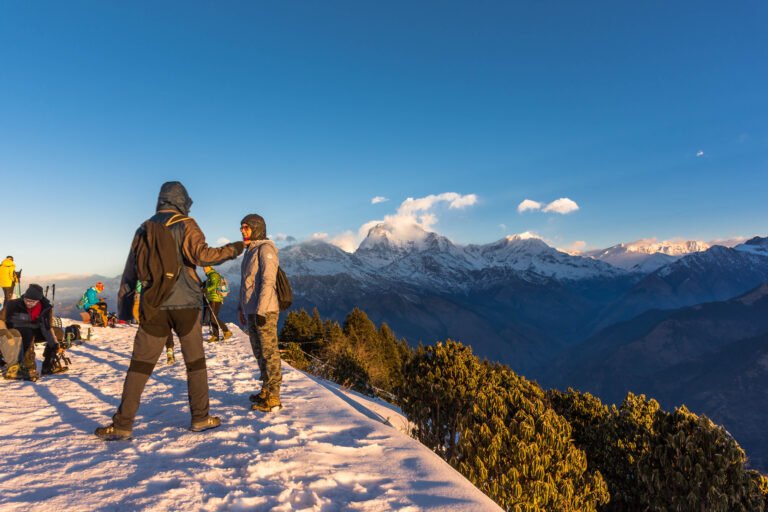
- Trekking consequence: with the Manaslu circuit shut for the autumn, trekkers concentrated on the Everest and Annapurna corridors, and lodges on both reported crowding.
What the October numbers show
October is the anchor month of Nepal’s autumn season. The monsoon has cleared, the high passes are still open, and the Everest, Annapurna, Manaslu and Langtang corridors all run at their annual peak. A 3.4 percent year on year increase is modest in percentage terms, but on a base of roughly 128,000 arrivals last October it means about 4,400 additional visitors in a single month, most of them concentrated in the same handful of valleys.
| Indicator | October 2026 | Source |
|---|---|---|
| Foreign visitor arrivals | 132,814 | Nepal Tourism Board, preliminary Immigration Department data |
| Year on year change | Up about 3.4 percent | NTB release via Tourism Info Nepal and Trekking to Nepal |
| Arrivals, January to October 2026 | About 1 million | Nepali Times, November 5, 2026 |
| Largest source country | United States, 17,437 | NTB country table |
| Largest source region | Europe, 39,877 (30.0 percent) | NTB regional table |
| Tourism share of GDP | About 6.7 percent, over one million jobs | Kathmandu Post reporting |
| Trekkers recorded in 2025 | 165,056, plus 334 expedition teams | Nepal Tourism Statistics 2025 |
Two cautions on the figures. First, these are preliminary immigration counts, not audited statistics, and NTB revises them. Second, the year on year comparison is against an October that was itself disrupted, which flatters the percentage. The trend is real, but a 3.4 percent gain does not mean the season felt normal to everyone working in it.
Americans overtake Indians: the source market shake up
For most of the last two decades India has been Nepal’s largest single source market by a wide margin, fed by open borders, road access and a huge repeat visitor base from Bihar, Uttar Pradesh and West Bengal. October 2026 broke that pattern.
| Rank | Country | Arrivals | Share of total |
|---|---|---|---|
| 1 | United States | 17,437 | 13.13 percent |
| 2 | India | 12,097 | 9.11 percent |
| 3 | China | 11,695 | 8.81 percent |
| 4 | United Kingdom | 9,385 | 7.07 percent |
| 5 | Australia | 9,352 | 7.04 percent |
Germany, Sri Lanka, Bangladesh, France and Myanmar completed the top ten. The movement inside that list matters as much as the ranking. American and Canadian arrivals were up about 30 percent on October last year, while Indian arrivals fell by roughly the same proportion, a swing confirmed both by the NTB release and by Kathmandu Post reporting on the Indian market.
The explanation is not mysterious. Long haul travellers book their Himalayan trips months ahead, usually through an agency, and by the time Nepal’s floods were dominating international headlines in late August and September, most of them had already paid and were not going to cancel a flight from Chicago or Munich over a road closure in Rasuwa. Indian visitors, who travel short notice, often overland, and react immediately to news of blocked highways, cancelled buses and district advisories, did cancel. The same floods that barely dented the American market wiped out a third of the Indian one.
That asymmetry has a geographic consequence. Indian visitors are the backbone of Pokhara, Lumbini and the Kathmandu Valley short break market. American, European and Australian visitors are the backbone of the trekking corridors. When one collapses and the other holds, national arrival totals barely move while entire towns empty out.
Europe is still the biggest regional bloc
| Region | Arrivals | Share |
|---|---|---|
| Europe | 39,877 | 30.0 percent |
| Asia, other | 27,040 | 20.4 percent |
| South Asia (SAARC) | 24,053 | 18.1 percent |
| Americas | 21,270 | 16.0 percent |
| Oceania | 10,143 | 7.6 percent |
| Other | 7,675 | 5.8 percent |
| Middle East | 2,335 | 1.8 percent |
| Africa | 421 | 0.3 percent |
Europe’s 30 percent share is the number that should interest trekking operators most, because European travellers skew towards long itineraries: the Annapurna Circuit, the Manaslu and Tsum valleys, Mustang, and multi week combinations that spend money in villages rather than only in Kathmandu and Pokhara. The Americas at 16 percent and Oceania at 7.6 percent add another bloc of long haul, high spend, high altitude travellers.
Read together, Europe, the Americas and Oceania account for more than half of October’s arrivals. That is a structurally different market from the one Nepal had in 2019, when Indian and Chinese visitors carried a much larger share, and it explains why trekking infrastructure rather than city hotels is where this season’s pressure landed.
Where the 132,814 went: Everest and Annapurna absorb Manaslu’s season
The most consequential line in the October reporting is not a number. It is this, from Nepali Times: with the Manaslu circuit closed, most trekkers diverted to the Annapurna and Everest trails, causing some overcrowding.
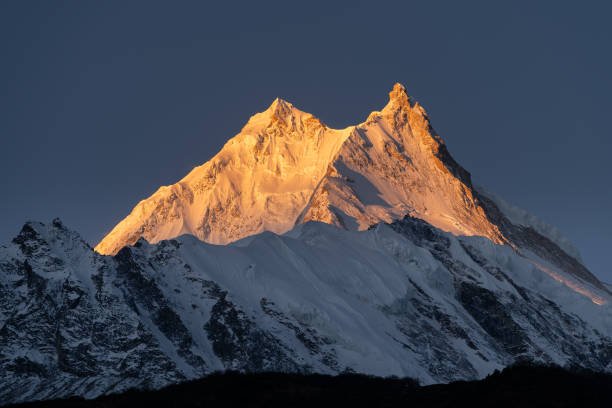
Manaslu has been effectively out of the autumn market since the Budhi Gandaki floods. The Namrung Khola flash flood on the Manaslu corridor in early September, and the heavier Budhi Gandaki flood of October 11 that swept away bridges and houses downstream, forced the Gorkha district administration to suspend the trail over the Larkya La (5,106 m). That removed one of Nepal’s three classic teahouse circuits from the board at exactly the moment bookings peaked. Read our earlier reporting on the trail suspension and on the Gorkha flood recovery for the detail.
Displaced Manaslu trekkers did not stay home. They rebooked onto the Annapurna Circuit, where Thorong La tops out at 5,416 m, and onto the Everest Base Camp trail through Namche Bazaar at 3,440 m. Both corridors were already running near capacity. The result is a season that looks, in aggregate, only slightly busier than last year, but feels considerably busier in Namche, in Ghorepani, in Manang and on the Lukla flight manifest.
For context on scale: Nepal recorded 165,056 trekkers in 2025, alongside 334 permitted expedition teams, according to Nepal Tourism Statistics 2025. Concentrating even two thirds of a comparable trekking cohort into two corridors instead of three changes the physics of the season: fewer beds per trekker, longer queues for the shared jeeps on the Annapurna road, and tighter helicopter availability for evacuations, which matters more than the queue for a room.
The Pokhara paradox: national numbers up, lakeside hotels half empty
In our Pokhara report this week we found that hotels were running at about 60 percent occupancy against 90 to 95 percent in a normal Kartik, with hoteliers blaming floods, damaged roads and blanket travel advisories that travelled further abroad than the actual damage did.
Both stories are true, and the new arrival data explains why. The visitors who came were long haul trekkers flying into Kathmandu and connecting to Lukla or Pokhara for a specific route. They passed through Pokhara, or bypassed it, rather than staying. The visitors who did not come were Indians arriving overland and by air for short lakeside breaks, and domestic tourists, and those are the two segments that fill Lakeside hotels. A national total that rises 3.4 percent on the strength of American and European bookings can coexist with a lakeside strip at 60 percent, because the two markets use the same town in completely different ways.
The lesson for the recovery period is about communication rather than marketing. Districts issued blanket advisories for high altitude travel during Cyclone Arnab in late October, which was correct for the passes and wrong as a signal for the country as a whole. Those advisories were read abroad as a nationwide warning.
If you are trekking in November or December
- The high pass window is closing. Thorong La on the Annapurna Circuit and the Cho La and Renjo La in the Khumbu become less predictable after the first week of November, and operators start routing groups around them rather than over them. If a pass crossing is the point of your trip, go now and build a spare weather day into the schedule.
- Book Khumbu teahouses ahead. With Manaslu’s cohort compressed into the Everest corridor, beds in Namche, Phakding, Dingboche and Lobuche are being reserved rather than filled on arrival. A guide or agency with lodge relationships is worth more this season than last.
- Treat Lukla flights as weather dependent. October volume has left the manifest full; November fog and cloud do the rest. Keep two buffer days before your international departure and know that helicopters are booking further out than in 2025.
- Check Manaslu status before you plan. The Larkya La route remains suspended. Confirm current status with the district administration or a licensed agency rather than relying on a guidebook published before the floods.
- Carry the right permits. TIMS and area permits are the registration system that rescue coordination depends on. Our permits guide sets out what each route requires and what it costs.
- Plan around Kathmandu’s air. The post monsoon dry season has begun and PM2.5 readings in the valley reached unhealthy levels this week, with stubble burning in the Tarai and across the border still to peak. Build a day of slack into the front of your trip for delayed mountain flights and consider doing valley sightseeing early in the morning.
- Consider a quieter corridor. Langtang is open, accessible and far less pressured than the Khumbu this month, and the valley’s teahouses were rebuilt after 2015 precisely for this kind of season.
Questions trekkers are asking
How many tourists visited Nepal in October 2026?
Nepal recorded 132,814 foreign visitor arrivals in October 2026, an increase of about 3.4 percent on October 2025, according to Nepal Tourism Board figures based on preliminary Department of Immigration data.
Which country sends the most tourists to Nepal now?
In October 2026 the United States was Nepal’s largest source market with 17,437 arrivals, ahead of India at 12,097 and China at 11,695. India has historically been Nepal’s largest source market, and the October ranking reflects a sharp, temporary fall in Indian arrivals after the autumn floods rather than a permanent change.
Is the Manaslu circuit open for trekking?
No. The trail over the Larkya La was suspended by the Gorkha district administration after the Budhi Gandaki and Namrung Khola floods, and remained closed through the autumn season. Trekkers who had booked Manaslu were moved onto Annapurna and Everest itineraries.
Is November a good month to trek in Nepal?
Yes, with caveats. November offers clear skies and stable conditions below the passes, but high pass crossings become riskier after the first week, Lukla flights are more weather prone, and the Everest and Annapurna corridors are busier than usual this year because Manaslu is closed.
Why are Pokhara hotels quiet if arrivals are up?
Because the growth came from long haul trekkers heading to Everest and Annapurna rather than from the Indian and domestic short break market that fills Lakeside hotels. Pokhara occupancy was about 60 percent in early November against 90 to 95 percent in a normal autumn.
Do I need a guide for trekking in Nepal?
TIMS registration is mandatory on virtually all teahouse routes, and restricted areas such as Upper Mustang, Upper Dolpa and Tsum require a licensed agency, a guide and a special permit. Check the current rules for your specific route before you travel.
Sources
- Nepal Tourism Board arrival figures for October 2026, reported by Tourism Info Nepal, November 2, 2026.
- Trekking to Nepal, October 2026 arrival breakdown, November 3, 2026.
- Nepali Times, “More North Americans”, November 5, 2026.
- Kathmandu Post, “Kathmandu Valley braces for another season of air pollution”, November 5, 2026.
- Nepal Tourism Statistics 2025, Ministry of Culture, Tourism and Civil Aviation.
- TravellingNepal reporting on Pokhara hotel occupancy, November 4, 2026, and on the Manaslu and Larkya La trail suspension, September 6, 2026.
- Wikipedia background on Thorong La, Larkya La and Namche Bazaar.

Related guides
- Annapurna region treks: complete guide, the pillar page for the corridor that absorbed Manaslu’s displaced trekkers.
- Everest Base Camp trek: complete guide, including acclimatisation and teahouse planning for a busy Khumbu season.
- Manaslu circuit trek guide, route, permits and the Larkya La crossing.
- Annapurna Circuit trek guide, including Thorong La logistics.
- Langtang Valley trek guide, a quieter alternative for late autumn.
- Nepal tourist visa and TIMS card guide, the registration every trekker needs.
- Nepal trekking safety and health guide, altitude, evacuation and insurance.
Share this content: